








V Centenary Isabella I de Castile
The Novel
"In a village of La Mancha, the name of which I have no desire to call to mind, there lived not long since one of those gentlemen that keep a lance in the lance-rack, an old buckler, a lean hack, and a greyhound for coursing..." thus begins the most treasured gem in Castilian literature, published in the year 1605 by Miguel de Cervantes Saavedra.
A novel that has triumphed worldwide and is perhaps, together with the Bible, the work that has been translated into more languages than any other. Moreover the characters from its pages have come to be veritable archetypes on a universal scale: Don Quixote, the idealist and dreamer; Sancho Panza, the loyal companion, practical and something of a fatalist.
Brief outline
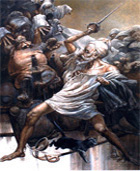
Don Quixote tells the story of a gentleman of rank from La Mancha who, from so much reading of tales of chivalry, goes insane and believes he is a knight-errant.
"...he became so absorbed in his books that he spent his nights from sunset to sunrise, and his days from dawn to dark, poring over them; and what with little sleep and much reading his brains got so dry that he lost his wits."
He leaves his village three times seeking adventures and "to set wrongdoings to rights", confusing reality with fiction and for the most part taking a thrashing. He finally returns home, gets sick, recovers his wits and dies.
Between his first sortie and his ultimate return to the hamlet, a whole series of small incidents are chronicled that our protagonist turns into authentic chivalrous episodes, though not always due to his own lunacy.
"The barber was all this time on his knees at great pains to hide his laughter and not let his beard fall, for had it fallen maybe their fine scheme would have come to nothing..."
Freedom
But what Cervantes advocates, and the reason why Don Quixote has become an immortal novel, besides the exceptional care taken with the language spoken by each of the characters, is his belief in FREEDOM. This topic appears continuously throughout the whole book, prompted by the years of captivity that Cervantes spent in Algiers:
" - Freedom, Sancho, is one of the most precious gifts that heaven has bestowed upon men; no treasures that the earth holds buried or the sea conceals can compare with it; for freedom, as for honour, life may and should be ventured; and on the other hand, captivity is the greatest evil that can fall to the lot of man."
Cervantes
Don Quixote of La Mancha was written in the 17th century by Miguel de Cervantes Saavedra, a Spanish poet, novelist and playwright born in Alcalá de Henares around 1547. He is considered to be the greatest Spanish writer of all time, and one of the best worldwide.
Autobiography
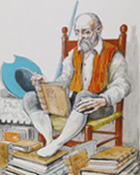
In the prologue to the Exemplary Novels Cervantes describes himself:
"The man you see before you, with aquiline features, chestnut-coloured hair, smooth and unwrinkled brow, bright eyes and curved though well-proportioned nose, silver beard that not twenty years ago was golden, large moustache, small mouth, teeth neither large nor small since he boasts only six of them, and those he has are in poor condition and even worse positions, for not one of them cuts against another; he has medium build, neither tall nor short, a healthy colour in his cheeks, fair rather than dark complexion, slightly stooping, and not very light on his feet. This, then, is a description of the author of "La Galatea" and "Don Quixote of la Mancha" and the man who wrote "Journey to Parnassus", which was modelled on the one by César Caporal Perusino,and other works which have gone astray, perhaps without their owner's name upon them. He is commonly known as Miguel de Cervantes Saavedra. He was for many years a soldier and a prisoner for five and a half after that, during which time he learned to cultivate patience in adversity. He lost his left hand in the naval battle of Lepanto to a blunderbuss shot, and although the injury is ugly he considers it beautiful because he incurred it at the most noble and memorable event that past centuries have seen or future generations can ever hope to witness, fighting beneath the victorious banners of the son of that thunderbolt of war, Charles V of happy memory."
The author of Don Quixote
He had turned 50 years old, and was the author of several works of poetry, plays and novels, when he published "The Ingenious Gentleman Don Quixote of La Mancha". It brought him immediate acclaim, though it did not free him from the financial difficulties that dominated most of his life. Not many years later came the publication of the copy written by Alonso Fernández de Avellaneda, and this spurred Cervantes on to completing the second part of Don Quixote. This was published in 1615 and contains frequent allusions to the "false Quixote".
""...The alcalde of the village came by chance into the inn together with a notary, and Don Quixote laid a petition before him, showing that it was requisite for his rights that Don Alvaro Tarfe, the gentleman there present, should make a declaration before him that he did not know Don Quixote of La Mancha, also there present, and that he was not the one that was in print in a history entitled "Second Part of Don Quixote of La Mancha, by one Avellaneda of Tordesillas."
He died on April 23rd 1616. The day has been declared by the UNESCO to be World Book Day.
Biography
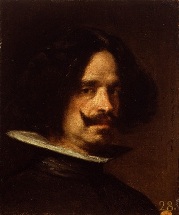
The Spanish painter, Diego de Silva y Velázquez, considered to be the most outstanding artistic celebrity of his time, was born in Seville in 1599. His mother was from Seville and his father was of Portuguese descent. Starting his career while still very young, Velazquez was greatly influenced, not only pictorially but also culturally and in literary themes by Francisco Pacheco, a painter in the mannerist style. At the age of 18 he launched out on his own after passing the painters' guild examination in his home town.
During his first stage, from 1618 to 1623, Velazquez painted some religious works and genre scenes in which he developed the chiaroscuro technique and which transmit the significant influence of Caravaggio's naturalism. His capacity for turning religious scenes into something intimate and realist is an important trait that he passed on to other artists of his time.
In 1623 he was appointed painter to the court and thus began a career in the royal household where he received several titles, among them Gentleman Usher and Knight of the Order of St. James. During this time he painted numerous portraits of the royal family, achieving great realism and sobriety in his handling of light.
During his two trips to Italy, one in 1629 and the other in 1648, Velazquez underwent a transformation in his painting style, imbuing his work with new light and brighter colors and achieving aerial perspective.
It is in the final stage of his work that he accomplished the greatest style development and painted his masterpieces. He died in Madrid in August 1660 after a long illness.
Works
Velazquez kept the somberness and the realism but was never a big enthusiast of mythological figures or of drawing human contours. What was important to the painter was not to amaze by his capacity to reproduce what he saw, but to demonstrate how far he could go with his painting.
Using a dazzling variety of brushstrokes and a subtle color harmony he achieved effects of form, texture, radiance and atmosphere which made of him a precedent for impressionism.
During the subsequent 18th, 19th and 20th centuries many were the artists who were inspired by the painting of Velazquez to fashion some of their most outstanding projects, in particular Francisco de Goya, Edouard Manet, Auguste Renoir, Claude Monet and Pablo Picasso.
The Meninas (The Maids of Honor)
This was painted in 1656 and has as its subject a portrayal of the infanta Margarita, the daughter of Philip IV, surrounded by her maids of honor and family in a room at the Alcázar in Madrid. This painting is considered to be one of the supreme works in universal painting and it was thereafter greatly imitated and admired by all. It was outstanding because in it the painter painted himself painting the painting, as if to affirm the supremacy of the art of painting. In addition the different perspectives are arranged to achieve an atmospheric impression giving rise to an extraordinarily complex spatial effect.
The Surrender of Breda
This is a painting of the historical episode which took place in Breda (Holland) in 1625 when the Dutch were defeated by the Spanish regiments and the city of Breda was taken. This would eventually end in defeat for Spain and independence for the Low Countries. The work was painted in 1634 for the Salon de Reinos at the Buen Retiro Palace. Velazquez achieved impressive realism in the painting and, rejecting conventionalities, he treated the subject of war with great sensitivity, placing the emphasis on the concepts of clemency and compassion for the defeated.
The Drunkards
This work was painted for Philip IV en 1629. The mythological nature and the amusing tone of the painting is conveyed by representing Bacchus as the god who gives man the gift of wine in order to somehow free him from life's everyday troubles. By mingling a tavern scene with the god of wine
Velazquez managed to introduce an irreverent aspect into a mythological subject.
Highly regarded piece
"The Ingenious Gentleman Don Quixote of La Mancha" met with instant success. This was borne out by the appearance in Lisbon of two false editions a few weeks after the novel was published. Then, only seven years later it was first translated into English by Thomas Shelton under the title "The History of the Valorous and Wittie Knight-Errant Don Quixote of the Mancha". Numerous translations have since followed, and, together with the Bible, it has become the piece of literature that has been translated into the most languages worldwide.
Far-reaching importance and repercussion
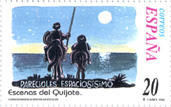
In the year 2002 it was elected the best work of fiction in history, out of a selection of 100 writers from 54 countries organized by the Norwegian Book Club and the Nobel Foundation.
It has been the inspiration for literary works, films, musical compositions, plays, ballets, paintings, postage stamps, comics, etc. the world over.
Furthermore it has given rise to a specific word in the dictionary of the Royal Spanish Academy:
quijote2. m. Man who prefers his ideals to his convenience and steadfastly in defense of causes that he considers just, without achieving his purpose. || 2. A tall, skinny man of serious countenance, whose appearance and character traits put one in mind of Cervantes' heroe.
Fourth Centenary of the publication of the novel
The year 2005 marks the fourth centenary of the first edition of the work. In commemoration of this anniversary, the Spanish Royal Mint has minted a coin set composed of three coins of 8 reales in silver with a face value of 10 Euros, a silver cincuentín with a face value of 50 Euros, and a coin of 8 escudos in gold with a face value of 400 Euros; in addition, a silver coin with a face value of 12 Euros and a commemorative coin of 2.
For additional information please visit the following links:
Miguel de Cervantes Virtual Library: www.cervantesvirtual.com
Biography
Isabella I of Castile, better known as Isabella the Catholic, was born in the town of Madrigal de las Altas Torres (Ávila) on April 22, 1451 in the palace of her father, John II of Castile, wedded to Isabella of Portugal.
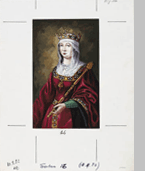
With slight prospects at birth of ascending to the throne of Castile, the declaration of the illegitimacy of her niece, Joanna "la Beltraneja", made Isabella heiress to her stepbrother, Henry IV, though she had to win the civil war of 1475-1479 in order to occupy the throne. Her marriage to Ferdinand of Aragon brought the reestablishment of order and monarchical authority to the two Castiles. Spain became a strong, dynamic and expansive nation that was to witness important events such as the conquest of Granada and of the greater Canary Islands, and the discovery of the New World in 1492.
These historical milestones universalized the figure of the Queen. She died in Medina del Campo on November 26, 1504. To commemorate the fifth centenary of her death, the Spanish Royal Mint has approved, minted and circulated a series of proof quality collector coins, and a 12-Euro coin, dedicated to the commemoration of the event.
For further information visit the following links:
- Cáceres County Council: Fifth Centenary of Isabella the Catholic. Archives in honor of Isabella the Catholic on the Fourth centenary of her Death in the Revista de Extremadura (1904).
- Archbishopric of Valladolid: official page Fifth Centenary of the death of Queen Isabella the Catholic (link in spanish).
- Medina del Campo: celebration for the Fifth centenary of the death of Isabella the Catholic in Medina del Campo (link in spanish).
- Madrigal de las Altas Torres: Fifth Centenary of the death of Isabella the Catholic (link in spanish).
Reign of the Catholic Monarchs
The monetary system during the reign of the Catholic Monarchs
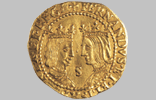
The reign of the Catholic Monarchs spanned the years between 1474 and 1504. It marked the beginning of a period of great progress and prosperity that would put Spain at the head of Europe for over a century.
By the determination of the Catholic Monarchs, Spain played the leading role in events of such significance that they would mark the course of its history, such as the unification of the different kingdoms under the Crown, the definitive incorporation of the Canaries to the Castilian Crown, the annexation of the Nazarí Kingdom of Granada, or the landfall of Christopher Columbus in the New World.
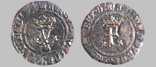
The monetary system was based on gold, silver and billon. The monetary diversity in existence in the different Spanish kingdoms on the accession of the Catholic Monarchs was influenced by two different areas: the Muslim and the European. The kingdoms that constituted the Crown of Aragon each issued their own coinage. During their reign Isabella and Ferdinand sought to unify the coin types, especially in Castile.
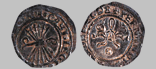
The first monetary standard for Castile is dated June 26, 1475. As the unit for gold it established the castellano, which depicted facing busts of the monarchs. It also established the doble castellano, a coin that was appointed the name of excelente on account of the purity of the metal used. This coin portrayed the sovereigns, and on the reverse the eagle of Saint John harbouring the coat-of-arms. For silver, the standard set the real, and its divisors, the medio real and the cuarto de real. In billon, an alloy of silver and copper, the coin to be minted was the blanca, with a motif representing the initials of the king and queen.
The "Pragmática" of Medina del Campo, dictated in 1497, established the guidelines for the minting of the new gold coin: the excelente de la granada (with the kingdom of Granada added to the coat-of-arms on the reverse), based on the Venetian ducat, a coin accepted in Europe and in use in Valencia and Aragon since 1483. This coin had multiples of 2, 4, 10 and 20, and a divisor, the medio excelente. This statutory provision was intended to unify the monetary system, and it also regulated the working of the mints and minters. A new denomination in silver was also introduced, the octavo de real.
By a Royal Warrant of 1503, Isabella commanded the coining in the Seville Mint of "the gold arriving from Hispaniola Island and from the other islands and lands of the Oceanic sea"; this mint would also strike coinage in silver and copper.
A Referent in History
Symbols of their reign. History's legacy
Isabella I of Castile and Ferdinand II of Aragón are without a shadow of doubt two great personalities in Spanish and European history, and the union of the two, reigning on terms of equality, was an unparalleled circumstance in the Europe of their day.
The importance of these two monarchs and the decisive events in which they played the lead have led succesors and subsequent governors to cast a look back upon their reign and take the splendour of their time as a point of reference. This fact has had a significant influence on the great number of representations that have been made of the Monarchs, of their characteristic symbols, and in short of their important historical period, in the different state documents from the early years of the past century. These are the documents that were designed and created by the Real Casa de la Moneda, (The Spanish Royal Mint), as the National Mint and Printing Office, and as the continuator of the activity carried out by the artisan workshops of former centuries.
The Catholic Monarchs adopted certain devices as their symbols. These have been maintained and even today some can be found in our national coat-of-arms. From Isabella we have the eagle of Saint John holding the arms of the kingdom, to which the sovereign added the motto "sub umbra alarum tuarum protege nos" (protect us beneath the shadow of your wings), due to the devotion of the queen for the Evangelist. The queen also used the emblems of the yoke and the eleven downward arrows that symbolize unity and the empire.
Ferdinand adopted the Gordian knot, alluding to the one Alexander the Great slashed with his sword. It is represented either independently or crossed by Isabella's yoke, with the initial letter "Y" making reference to the queen.
The device of Don Juan Carlos I still preserves the symbols par excellence of the Catholic Monarchs: the yoke and the arrows together with the Gordian knot.
The Composition
The Narrative
The epic poem called "The Song of My Cid" is the first extensive narrative work in Spanish literature penned in a Romance language. It is composed of 3,735 anisosyllabic verses that relate heroic exploits freely adapted from the later years in the life of the Castilian nobleman Don Rodrigo Díaz de Vivar.
The poem is written in mediaeval Castilian and was composed around the year 1200 (between 1195 and 1207). The original title is not known, though it was probably called epic poem or song, terms the author uses to describe his work in verses 1085 and 2276 respectively.
The Song of My Cid addresses the subject of honor, a quality of prime importance to the people of that period. The need to restore lost honor is what drives the exploits undertaken by the hero.
The poem begins with the Cid's exile, the primary cause for dishonor, after an accusation of theft. This dishonor also means being deprived not only of his estate or possessions in Vivar but also of the custody of his family.
After concluding the conquest of Valencia, achieved by his good judgment and shrewdness, the hero receives the royal pardon and a new estate, the fiefdom of Valencia. In order to ratify his new status as lord over vassals, marriages are arranged for his daughters with lineages of the greatest prestige, such as those of the princes of Carrión.
Fortune, however, is fickle and this moment of happiness is turned into a new fall from honor for the Cid by reason of the grave offense caused by the princes against his daughters, who are humiliated, badly wounded and left abandoned in the oak forest of Corpes, an incident that under mediaeval law meant the de facto repudiation of the daughters by the Carrión household.
This leads the Cid to allege nullity of the marriages in a trial presided by the king. The princes of Carrion are publicly disgraced and despoiled of the privileges that they previously possessed as members of the royal entourage. El Cid's daughters on the other hand enter into arranged marriages with Spanish kings, thereby rising to the top of the social ladder.
The Author and the Manuscript
The Author
Although this is an anonymous work, an analysis of the preserved text shows that it belongs to a learned author who had an accurate knowledge of the law in force at the end of the 12th and beginning of the 13th centuries, and that he was familiar with the area around Burgos. Different theories have been put forward on his identity: it has been said he was a minstrel from Medinaceli, or one from San Esteban de Gormaz, that he was a poet from the Jiloca or Jalón river valleys and even that he was Jerome of Périgord.
In May of 1245 by the Julian calendar (1207 A.D.) an abbot who is identified simply as Pedro finished copying a manuscript of almost four thousand verses. In the conclusion he availed himself of the opportunity to request, in the ingrained tradition of mediaeval scribes, that he be given something in return: "quien escrivió este livro, dél[e] Dios paraíso.¡Amén! Per Abbat le escrivió en el mes de mayo, en era de M e CC e XLV años". ("Whosoever wrote this book, may God grant him paradise. Amen! Abbot Pedro wrote this in the month of May in the year of our Lord 1207.)
Abbot Pedro's copy contained an account of the life of Rodrigo Díaz de Vivar. This work, like so many coeval ones, lacked a title but would much later become known as the Song of My Cid or the Poem of My Cid. Abbot Pedro had copied, therefore, an earlier text whose date of authorship is still open to debate.
In the Middle Ages "to write" merely meant "to be the copyist". For what we understand today as the author it would have had to say "composed" or "made". This invalidates the theory of Colin Smith that the author was the Abbot Pedro.
The Manuscript
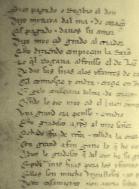
There is only one copy in existence and it is currently housed in the National Library (Biblioteca Nacional) in Madrid. It is a volume of 74 thick parchment sheets, three of which are missing, one from the beginning and two between pages 47/48 and 69/70. A further two sheets serve as flyleaves. Many of the pages have stains from the reagents that were utilized since the 16th century to facilitate the reading of what had probably faded. The binding of the tome dates from the 15th century. It is made of wood covered in dressed sheepskin leather with stamped ornamental scrolls.
The manuscript is a continuous text without any separation between the songs, or spacing between the verses. These always begin with a capital letter.